
Many artists run their first ad without knowing exactly what they hope to achieve, who they should reach, or how to measure whether it worked. The result is often wasted budget on confusing tests and metrics that seem important but say nothing about the campaign’s real reach. If you’ve never advertised before, organizing these three areas—objective, audience, and creative—helps avoid waste and gives you more confidence in your initial choices. This post offers practical questions to answer before you press the publish button.
Diagnose the problem: why advertising can feel like a gamble
Advertising for the first time feels like a gamble when you’re not clear about what you want to achieve. Without a defined objective, any number can seem good; without a clear audience, the creative doesn’t speak to the people who matter; without benchmarks for interpreting results, decisions become guesswork. These gaps lead to wasted budget and frustration. Pinpointing exactly where information is missing is the place to start.
Decide or change your approach: questions that prevent useless tests
Before creating the campaign, answer direct questions: What real objective do I want to achieve with this ad? Who is the person who should respond now, and why? What creative asset has a chance of attracting that person in just a few seconds? These answers help you decide whether your first action should be an audience test, a creative variation, or objective validation. With clarity, you reduce random attempts and focus your budget on the most relevant hypotheses.
What the ebook teaches: practical focus, no jargon
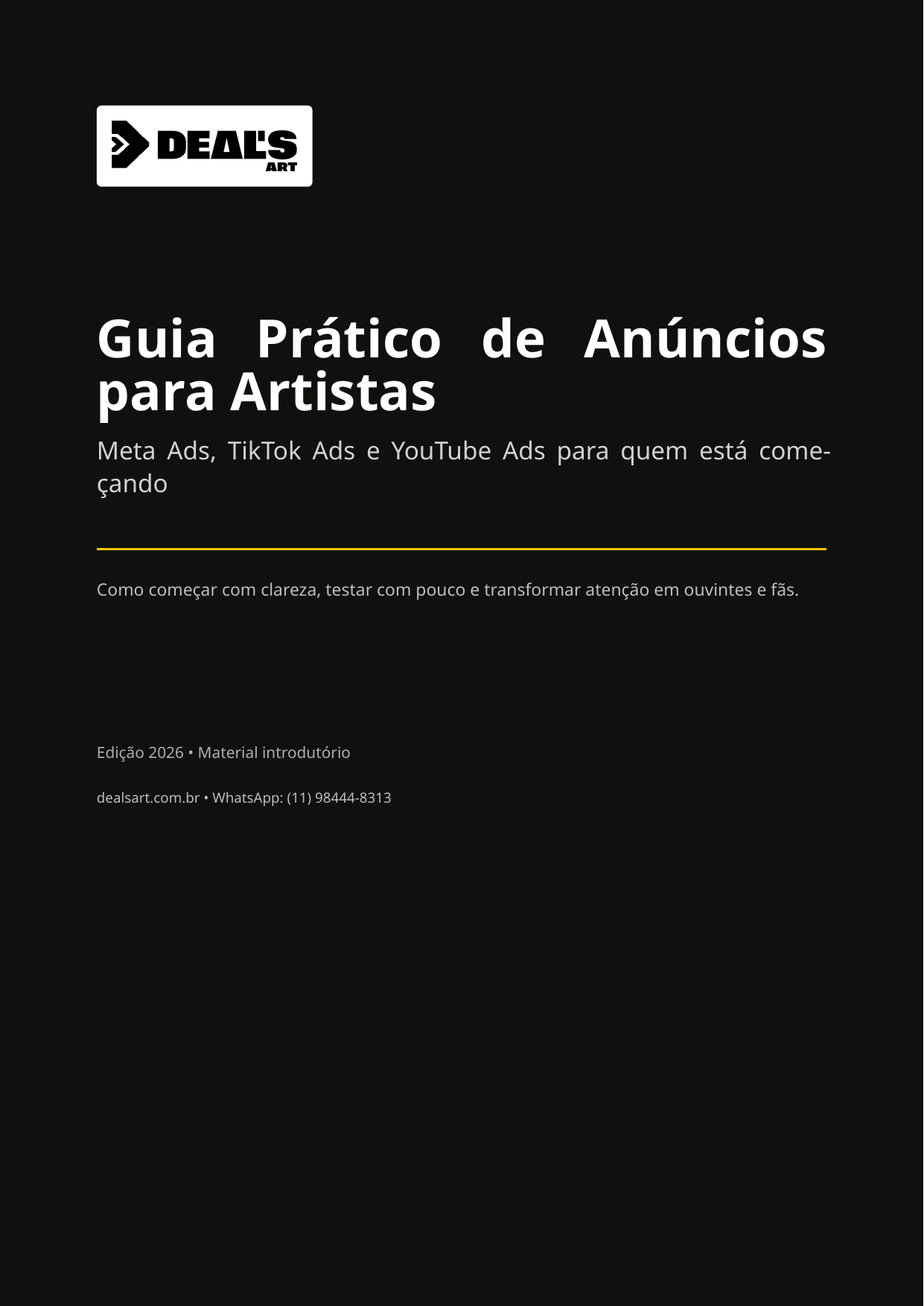
The Practical Guide to Advertising for Artists explains, in simple language, how to plan ads on the three most widely used platforms today: Meta Ads, TikTok Ads, and YouTube Ads. The guide shows you how to put together a 7-day test plan to validate initial hypotheses without extending your investment. It also advises which metrics to avoid—the so-called vanity metrics—and how to interpret results in a way that informs decisions about your objective, audience, and creative.
Practical application: from diagnosis to your first 7-day test
Use the diagnostic questions to choose a clear hypothesis and put together a 7-day test plan, as suggested in the ebook. Decide which platform to prioritize based on your audience and creative format, set up small variations, and note objective success criteria that aren’t vanity metrics. By the end of the week, you’ll have enough data to adjust your audience, change your creative, or change your objective without relying solely on intuition. This is the way to make more informed initial decisions.
Who this material is for
The Practical Guide to Advertising for Artists was created for independent artists, bands, producers, and small teams advertising for the first time. It’s useful for anyone who needs to organize their objective, audience, and creative before investing and prefers straightforward explanations without unnecessary technical terms. If your team is small and you need to make initial investment decisions clearly, the content offers actionable steps starting with your first campaign.
Clear commercial conclusion
If your priority is to spend less on useless attempts and have practical criteria for deciding on your objective, audience, and creative, the Practical Guide to Advertising for Artists can help you plan your first ad. The guide provides instructions for Meta Ads, TikTok Ads, and YouTube Ads, a 7-day test plan, and guidance on interpreting results without being misled by vanity metrics. Buying the guide means choosing a clear roadmap for your first test, with no promises of guarantees, just applicable methods.
A consistent strategy connects creativity, context, and relationships. If you’d like to organize your next cycle with an integrated perspective, Deal's Art can help define your project’s priorities.
Present my project