
Independent artists usually take on many roles: writing songs, choosing repertoire, negotiating production, recording content, responding to their audience, and still deciding how to release their music. Deal's Art mentoring organizes all of this into a work plan that respects the artist's current stage and available resources.
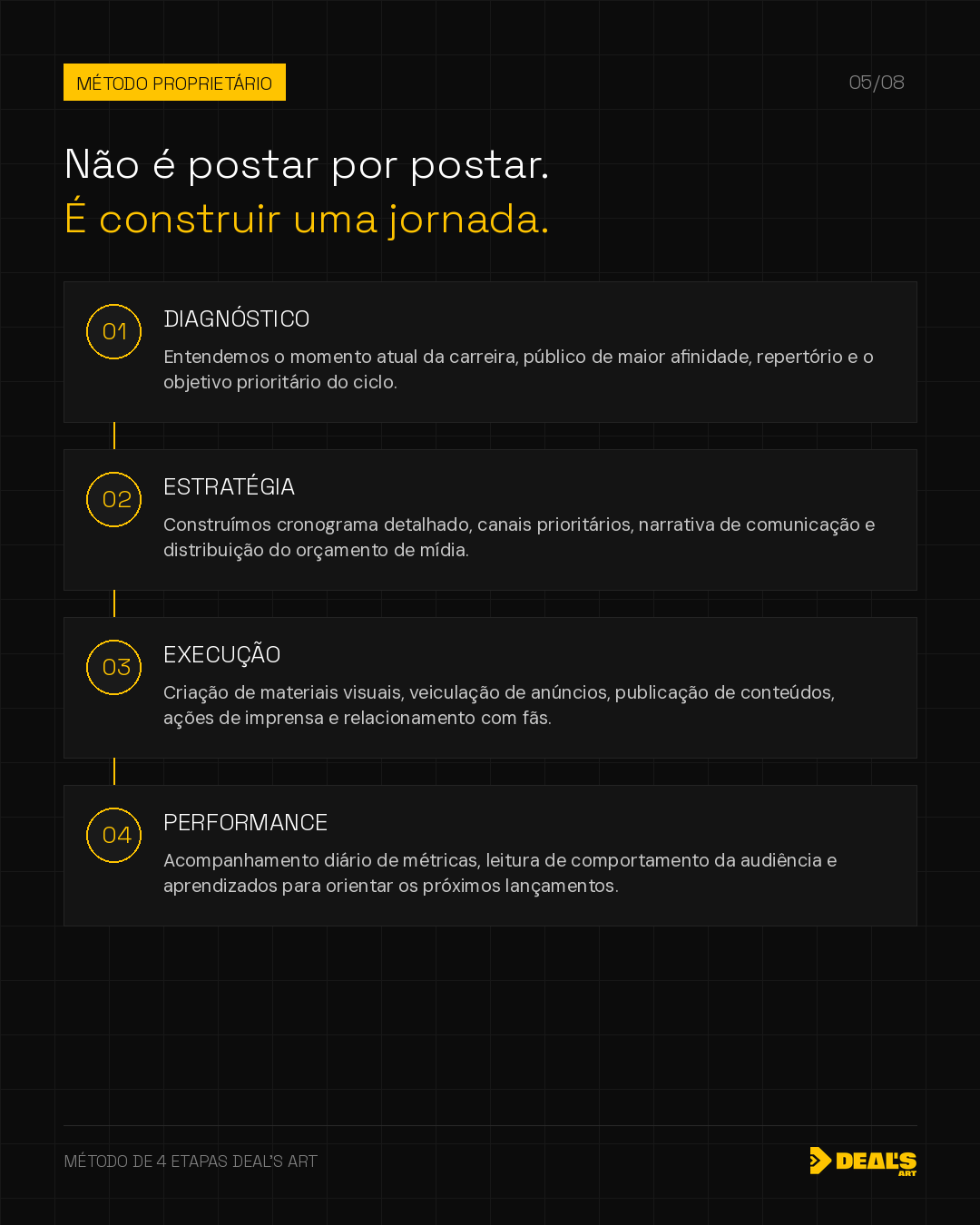
Project assessment
The conversation begins with an understanding of the artist's current stage. Repertoire, identity, social media, platforms, upcoming releases, shows, team, and goals help create an overview. The aim is not to look for flaws, but to understand what is already in place and where a well-made decision could have the greatest impact.
Setting priorities
Not every problem needs to be solved at the same time. For some projects, the urgent task is preparing a debut; for others, it's organizing their digital presence, building a fan base, or shaping a new phase. Mentoring helps choose a workable sequence instead of spreading energy across disconnected areas.
An action plan with clear responsibilities
The strategy needs to fit into the artist's routine. That's why recommendations are translated into actions, deadlines, and responsible parties in line with the artist's resources. The plan may include calendar organization, release materials, content direction, channel priorities, and metrics analysis, always according to what the project needs to develop.
Communication direction
How the music reaches its audience is also part of the conversation. Mentoring identifies stories, formats, and entry points that make sense for the work and its intended audience. The focus is not on copying trends, but on making communication more recognizable and easier to sustain.
Support with platform decisions
Spotify, Instagram, TikTok, YouTube, WhatsApp, and paid media can serve different functions. Mentoring helps determine where the artist should focus their energy at that moment and how to build pathways between channels, so each platform does not end up with an isolated strategy.
Reviewing results and making adjustments
The review continues after implementation. Which content sparked conversation? Where did new listeners come from? Which city responded? What kind of video held people's attention? The analysis is not about chasing a single metric, but about turning experience into a foundation for the next cycle.
Autonomy as the goal
Well-guided mentoring leaves the artist and team feeling more confident about making decisions. By understanding the reason behind each priority, the project can execute more independently, evaluate opportunities, and adapt its course without losing sight of its identity.
Who this conversation makes sense for
Mentoring can support artists preparing for a release, projects that feel the need to reposition themselves, or teams already doing a lot but needing to connect the different areas. It can also help those just starting out who want to build a career structure before spending energy on random paths.
What mentoring does not promise
There is no guarantee of going viral, playlist placements, or specific numbers. The offer is more solid: organize decisions, improve the quality of preparation, and create the conditions for the project to communicate better with the right people. Career results are built over time, with repertoire and consistency.
A proportionate strategy
The plan does not need to look like one from a major record label to be effective. Mentoring takes into account time, budget, materials, and actual availability. An action that can be carried out well is usually more valuable than a calendar that is impossible to maintain.
How to get started
An initial conversation can start with a simple question: what needs to move forward now? The answer may involve a release, content, positioning, audience, or organization. From there, Deal's Art assesses the situation and helps design the most suitable route for the next stage.
An integrated view
Even when the initial focus is on a single area, mentoring looks at the whole picture. A media campaign, for example, needs to consider the content that receives the audience; a release needs to consider the profile, community, and what comes next. This perspective avoids solutions that work only on paper.
From conversation to plan
The clarity gained through mentoring should become a working document: priorities, next steps, channels, responsible parties, and follow-up criteria. This allows the team to refer to the strategy and update it as the project advances.
Pace of progress
Careers develop in cycles. Some changes happen quickly; others require repetition and time to mature. Mentoring organizes this pace so artists do not confuse urgency with progress and can recognize tangible advances over time.
A strategy that respects the work
The goal is to expand the music's ability to find its audience without changing the artist's identity. Every communication decision needs to start from the work and the artist's career stage, not from an external formula that ignores what makes the project unique.
A consistent strategy connects creativity, context, and relationships. If you'd like to organize your next cycle with an integrated perspective, Deal's Art can help define your project's priorities.
Present my project