
Managing an expanding catalog requires technical choices that affect distribution, rights administration, and day-to-day operations. Many teams face problems with inconsistent metadata, fragmented reports, and manual processes that hinder growth. Choosing the right aggregator is an operational priority: errors increase costs and delay releases. This article presents technical criteria for evaluating providers and explains how to request a proposal tailored to your project.
Service models and platform coverage
Aggregators use a range of service models: some focus solely on technical distribution, while others offer commercial support, pitching, and access to promotional tools. Check geographic coverage and presence on relevant regional platforms, since not all aggregators submit catalogs to every streaming service or digital store. Also evaluate complementary channels such as licensing for libraries, digital radio, and video-use services. Understanding the scope helps avoid surprises as the catalog grows into specific markets.
Metadata management and catalog integration
Metadata quality and consistency affect identification, reporting, and revenue. Look for platforms that support bulk imports, field normalization, and rules for ISRCs, UPCs, and artist credits. APIs for integration with your management system (CMS, DAM, or ERP) reduce manual work in large catalogs and enable workflow automation. Test bulk correction capabilities and change logs for auditing when corrections are needed.
Reporting, transparency, and financial control
Granular, up-to-date reports are essential for monitoring performance and revenue by work, territory, and partner. Review processing frequency, export formats (CSV, XSLX, API), and compatibility with BI tools. Understand retention and reconciliation policies: how discrepancies are handled, distribution timelines, and any deductions or administrative fees. Transparent fees and revenue reporting make financial governance easier as the catalog grows.
Operational scalability and technical support
Check technical limits such as the number of items per delivery, processing latency, and the ability to handle release peaks. SLAs, response times, and access to qualified technical support affect daily operations, especially during intensive release periods. Also consider onboarding and training processes for your team, as well as technical documentation and test environments. Your choice should account not only for the catalog’s current state, but also for projected growth and operational complexity.
Practical criteria for contracting and professional execution
Define minimum requirements: platform coverage, API capabilities, accepted formats, and support levels. Request a pilot test with a representative subset of the catalog to assess metadata processing, delivery time, and report quality. Ask for clear contractual clauses on intellectual property, ISRC/UPC management, and catalog takedown or migration policies. Assess total costs, including delivery, storage, support, and potential integration fees; if you have questions about contracts or rights, consider consulting a specialized legal or accounting professional. Document internal processes and SLA agreements to reduce operational risks as you scale.
How Deal's Art can help without promising results
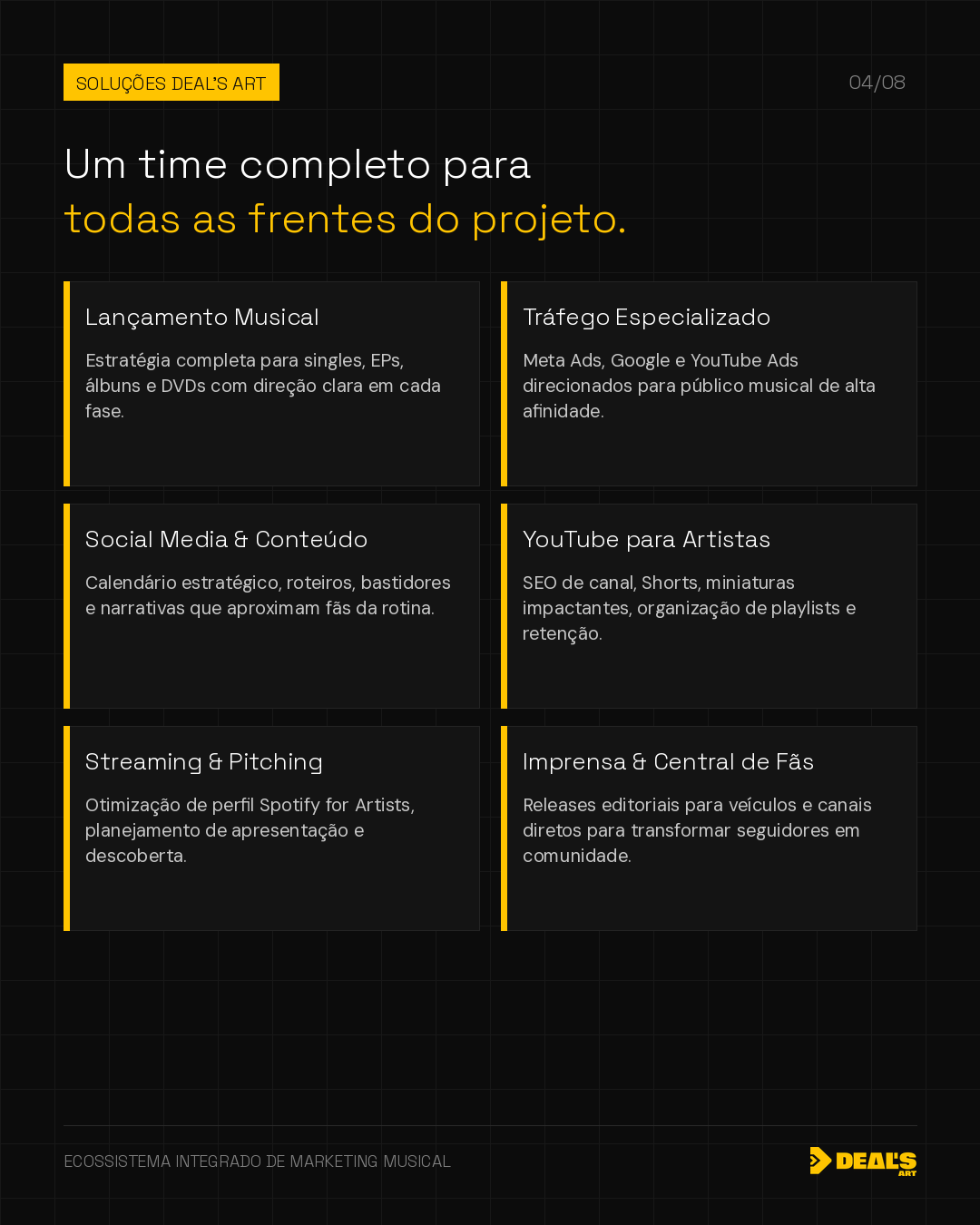
Deal's Art connects artists, labels, and streaming service providers, offering technical and operational assessments of potential partners. We can map your catalog’s needs, develop an RFP scope, and coordinate pilot tests with selected aggregators. We do not promise automatic results; we explain possibilities, impacts, and trade-offs so your decision is informed by the context and expected execution. For proposals and technical alignment, we recommend a conversation to assess the scope and prepare a customized proposal.
A consistent strategy connects creation, context, and relationships. If you want to organize your next cycle with an integrated perspective, Deal's Art can help define the project’s priorities.
Present my project