You have a finished song and need its visuals to communicate professionalism, concept, and relevance today—when covers, assets, and digital formats compete for attention across feeds, platforms, and press kits. Many artists, labels, and managers underestimate how weak design or visuals disconnected from their positioning can hurt media opportunities, editorial placement, and audience perception. Addressing this now means avoiding costly rework, protecting the release schedule, and ensuring all the assets speak the same visual language. Below, we explain what an agency delivers in cover and campaign design, how to evaluate proposals, and how to move forward with confidence.
Scope of deliverables: what the visual package includes
A professional package goes beyond the cover image: it includes optimized versions for platforms (streaming, social media, press kits), fonts and a color palette, variations for singles and album art, and final files ready for upload and print. Ask for specifications on formats and resolutions for each channel, and request editable files for future adaptations. From the briefing stage, ask about intended uses (videos, physical covers, merchandise) to ensure nothing falls outside the scope and to avoid extra costs later.
Creative process and deliverables: how a campaign is built
The process begins with a strategic briefing that defines the concept, visual references, and target audience; from there come mood boards, sketches, and iterations until final approval. Set deadlines and the number of revisions in the contract to keep the release schedule predictable. Check whether the agency offers art direction for photos, image editing, and assistance applying the assets to promotional materials such as banners, story templates, and press dossiers.
Rights, files, and governance: what you need to clarify
Define in the contract who owns the rights to the images, illustrations, and fonts used, and request the source files (PSD, AI, INDD) when accepting the work. Request documentation for stock image and paid font licenses to avoid legal issues later. Also agree on a process for storing and delivering master files so your team and distribution partners can quickly access the official materials.
Integration with content and the release: align design and campaign
Design is not just aesthetics; it is part of the release narrative and should align with the schedule for content, ads, and activations. Plan to deliver the assets in stages, synchronized with teasers, pre-saves, music videos, and press materials to maintain consistency. Ask the agency for a plan to apply the visual elements to posts, video covers, and show materials, reducing rework between creation and execution.
Hiring criteria and warning signs in proposals
Evaluate portfolios for conceptual coherence, not just technical beauty, and ask for examples of projects with a scope similar to yours. Confirm the cost structure, deadlines, and number of revisions; proposals that omit this information are a warning sign of improvisation and budget overruns. Seek references, validate processes (briefing, deliverables, backups), and prefer agencies that provide a detailed schedule and clear clauses on rights and final deliverables.
How Deal's Art works and next steps
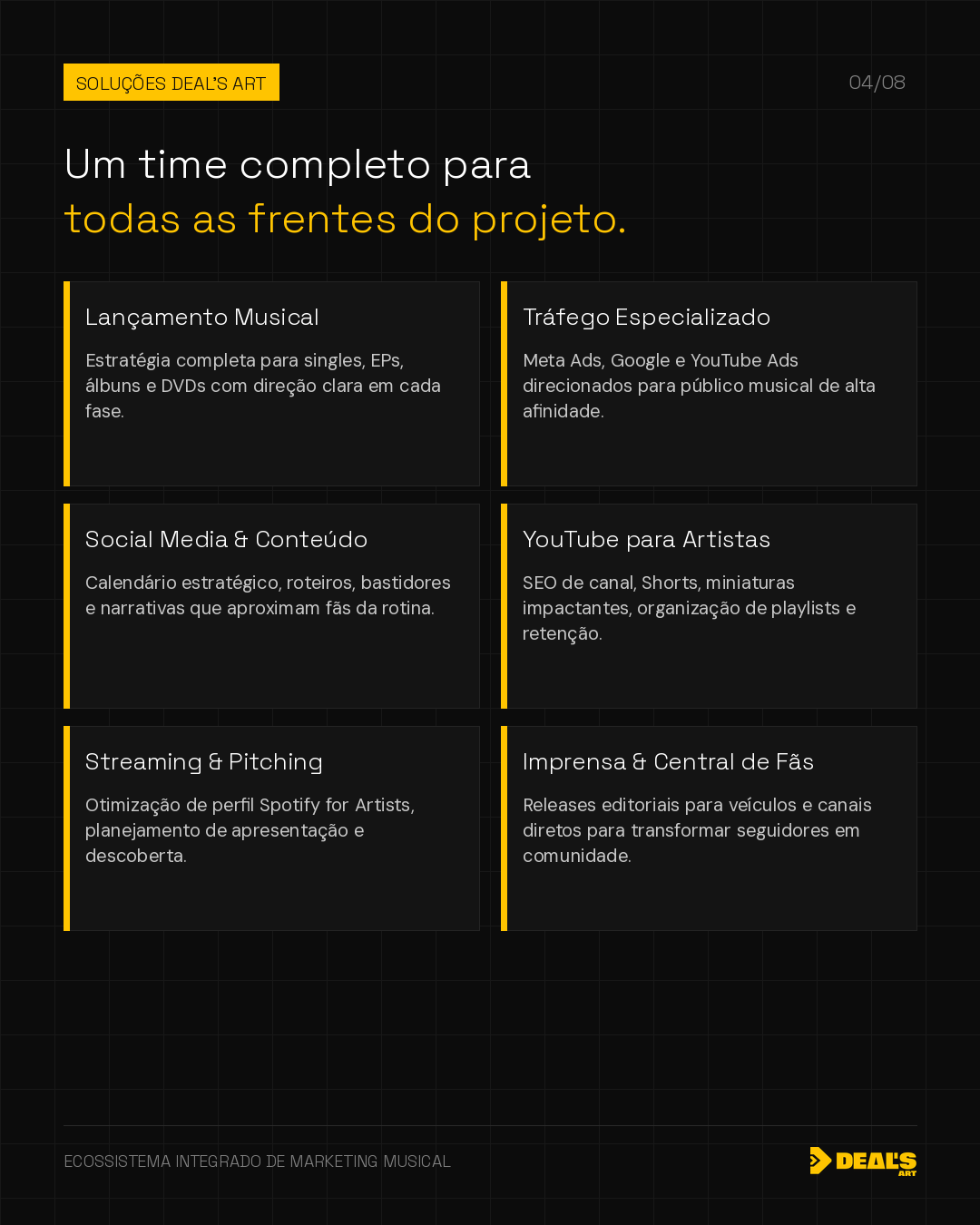
At Deal's Art, we deliver visual packages designed around the artist's strategy: we define the concept, create the artwork, and prepare all the files and applications needed for the release. We work with positioning-led briefs, deadline management, and file governance, and adapt the scope to your needs and budget—terms and prices depend on the project. If you want to reduce risk and ensure your visual identity supports your release campaign, we can assess your case and propose a customized package.
A consistent strategy connects creativity, context, and relationships. If you'd like to organize your next cycle with an integrated perspective, Deal's Art can help define the project's priorities.
Present my project