
Inconsistent or poorly prioritized metadata costs opportunities in international markets. Labels and distributors that do not segment metadata by territory and service lose visibility and operational efficiency. As global revenue streams grow, organizing the catalog shifts from a nice advantage to a strategic necessity. The window for correcting errors and aligning actionable items is limited by release schedules and pitching cycles.
Why prioritize territories and services in metadata
Not all markets require the same formats, fields, or catalog presentation strategies. Prioritizing territories makes it possible to adapt metadata to local requirements, languages, and consumption practices that affect editorial curation and algorithms. Prioritizing by service: Spotify, Apple Music, Amazon, etc.: helps avoid technical issues such as ignored fields or incorrect mappings. This work reduces operational rework and helps align pitching efforts and regional campaigns.
Practical mapping: essential fields and market-specific variants
Start by creating a matrix of essential fields (performers, credits, composition, ISRC, language, territoriality) and variants required by each service. Identify fields that require strict standardization and others that allow contextual variation, such as alternate names and transliterations. Include rules for multilingual releases, regional versions, and compilations, and document technical dependencies that cause ingestion errors. Clear mapping reduces rejections and speeds up catalog approvals.
Tactical prioritization: how to choose where to focus efforts
To decide on priorities, combine market data with commercial objectives: territories with higher historical revenue, the presence of key artists, and strategic release windows should receive attention first. Also consider local barriers to entry, rights regulations, and service-specific formats that may require immediate adjustments. Plan correction sprints by batch of releases instead of trying to modify the entire catalog at once. This approach makes it possible to measure impact and adjust criteria before expanding operations.
Operationalization: metadata processes, tools, and governance
Define clear roles across A&R, licensing, data ops, and distribution to avoid duplication and information loss. Automate basic validations using rules and checklists, and maintain a centralized source of truth for metadata with change logs. Choose tools that support versions by territory and integration with platform pitching systems whenever possible. Establish internal SLAs for error correction and periodic reviews aligned with the release calendar.
Criteria for hiring professionals or carrying out this work professionally
Look for professionals or agencies with proven experience in catalog operations and practical knowledge of the technical requirements of leading streaming services. Assess their portfolio, focusing on projects of similar scale and territorial complexity, and request demonstrations of metadata matrices and workflows. Verify their ability to integrate with your systems (e.g., DSP ingestion, MAM, CRM) and automated QA processes. Consider a project-based model with defined deliverables and reviews, and request technical references for validation.
How Deal's Art works in this context and next steps
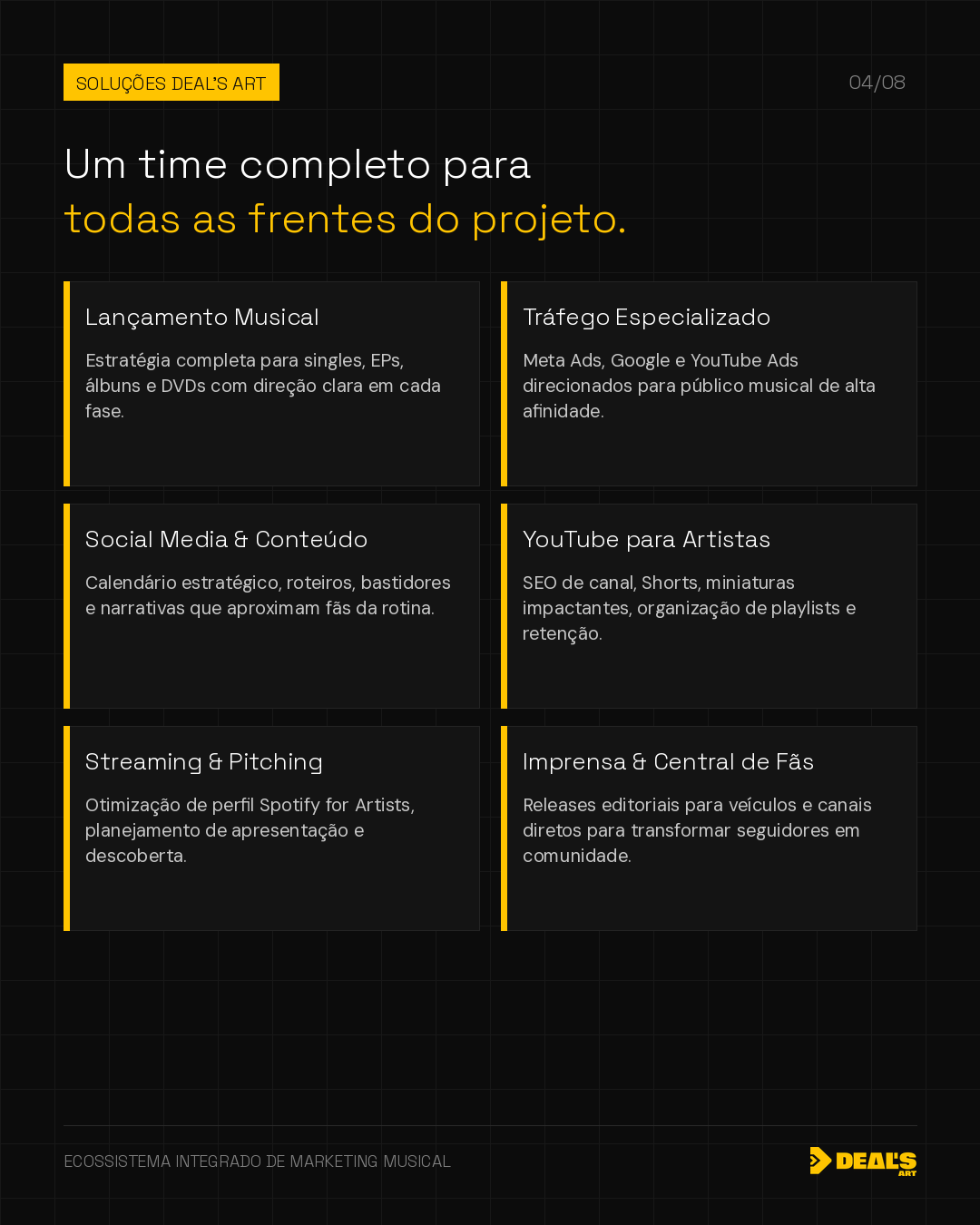
Deal's Art offers catalog organization assessments and metadata adjustments with a practical focus on prioritizing by territory and service, aligning operations and music pitching. We do not promise automatic results: effectiveness depends on the state of the catalog, execution, and platform policies. In an initial assessment, we map critical issues, propose a priority-based roadmap, and define the scope for technical work and integration. To discuss a plan tailored to your catalog, schedule an assessment meeting.
A consistent strategy connects creation, context, and relationships. If you want to organize your next cycle with an integrated perspective, Deal's Art can help define the project's priorities.
Present my project