
Wasted spend on YouTube campaigns often starts before the ads run: there is no alignment between the people producing the video and those buying media. Without a minimum data flow, tests are poorly planned, creative assets are underused, and learnings are lost. Organizing what information to exchange, when, and in what format is a high-impact way to optimize performance and reduce costs. This practical guide outlines the minimum set of data and processes needed to urgently eliminate operational noise.
Essential creative asset data
Before any campaign goes live, the video team should deliver a minimum package with final files, variants, and clear metadata. Include the exact duration, cut points (0–6s, 6–15s, 15–30s), versions with and without audio/music, and a high-resolution thumbnail file. These items allow the media team to choose formats and timestamps to test without recreating assets. Standardized deliverables reduce rework and prevent launches with versions that are unsuitable for the auction.
Performance metrics and hypotheses
Share the creative hypotheses and metrics that matter for the project: campaign objective (awareness, consideration, conversion), target 6s/15s view rate, expected CTR, and secondary KPIs such as view-through rate. The video team should document the creative rationale (for example: opening with the artist's face for audience A). Recording hypotheses turns failures into actionable learning and lets the media team adjust bids and targeting based on concrete criteria.
Audience and targeting data
The media team needs the ideal audience profile: demographics, interests, similar channels, and viewing behaviors (for example: average watch time for videos in a genre). Also provide exclusion lists, regions, and critical viewing windows. When the video team knows these constraints, it can adapt cuts and messaging for specific audiences, avoiding creative assets that perform only in irrelevant niches. This reduces wasted impressions and improves budget effectiveness.
Sharing format and frequency
Standardize delivery formats: an organized folder (drive/asset manager) with a naming convention, a metadata spreadsheet in CSV or Google Sheets, and an executive summary in PDF. Set checkpoints: final asset delivery (D-5 before campaign start), hypothesis alignment (D-7), and an initial learning report (D+7 after launch). Consistent file formats and cadence ensure that media teams can operationalize tests immediately without waiting for ad hoc inputs.
Criteria for hiring or engaging a specialist
Look for professionals with proven experience in YouTube video campaigns and technical knowledge of the platform's formats and limits. Assess portfolios in terms of process: whether they provide delivery templates, use naming conventions, and have a track record of integrating with media teams. Prefer people who can turn creative hypotheses into actionable metrics and provide clear documentation (CSV/JSON for metadata). In the contract, clearly define the scope of deliverables, schedule, and responsibilities: who submits assets, who makes corrections, and validation deadlines.
Why structure this flow and how Deal's Art works
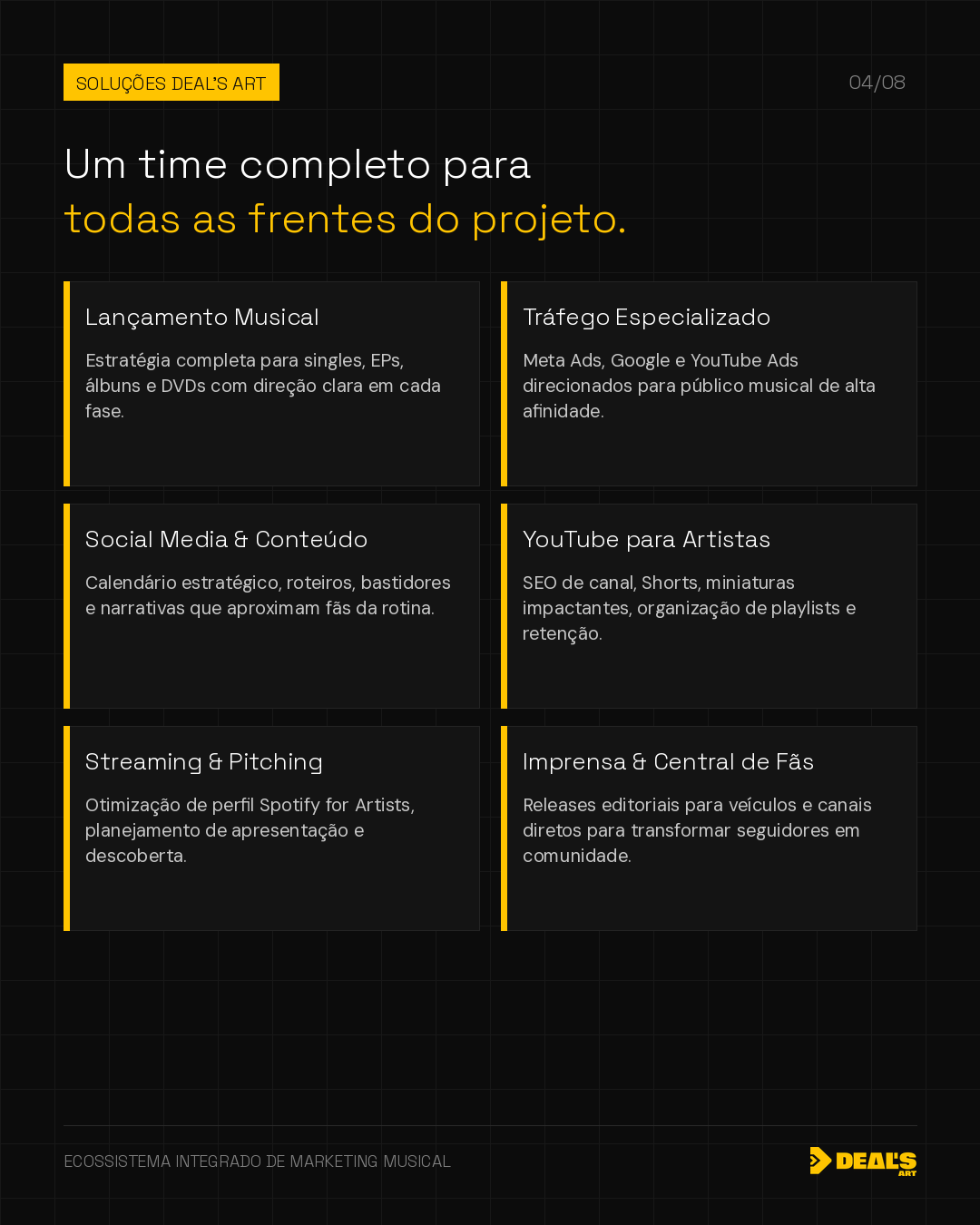
A minimum data flow reduces waste by preventing invalid tests, accelerating optimization, and preserving learnings across campaigns. Deal's Art offers consulting and campaign operations to organize deliverables, standardize metadata, and align hypotheses between video and media, without promising specific results. For projects, scope and investment depend on channel needs and may require a technical assessment. Request an assessment of your channel's data flow to understand where spend is leaking and how to mitigate operational risks.
A consistent strategy connects creation, context, and relationships. If you'd like to organize your next cycle with an integrated perspective, Deal's Art can help define the project's priorities.
Present my project