
Label managers and catalog owners often discover incompatibilities between an aggregator's compensation model and a project's accounting or strategic needs. This mismatch can lead to payment delays, difficulty auditing revenue, and hidden commission costs. With the growth of monetization methods and reporting requirements from partners and artists, choosing an aggregator is no longer just about price. Diagnosing compatibility today prevents rework and decisions that affect distribution and financial planning.
How compensation models vary among aggregators
Aggregators may operate on a percentage commission on revenue, a flat fee per release, an annual subscription, or hybrid models. Each option has different accounting implications, especially when a catalog includes revenue from secondary uses, syncs, or complex splits. The right choice depends on release volume, expected margins, and the profile of contracts with artists and administrators. To map the actual cost, simulate revenue scenarios and understand contractual clauses on payouts and withholdings.
The impact of reporting on catalog governance
Reports with an appropriate level of detail are essential for reconciling revenue, auditing payments, and meeting tax and contractual obligations. Some aggregators provide only reports aggregated by period, while others provide details by territory, DSP, and track. A lack of transparency makes it difficult to identify discrepancies between platforms and estimate future revenue for planning. Prioritizing aggregators that support integration with ERPs or BI tools makes it easier to centralize catalog governance.
Common risks of migrating without a diagnosis
Rushed migrations can lead to loss of history, payment delays, and errors in copyright splits. Format and metadata incompatibilities increase manual rework and can affect availability in playlists and artist profiles. Without prior checks, exclusivity clauses and termination notice periods can create windows when content is exposed without active distribution. A diagnosis before migration reduces the likelihood of these problems and makes it possible to plan contingencies.
How to assess compatibility by catalog type
Independent catalogs with few releases have different needs from labels with dozens of titles per month or catalogs with a high number of splits and administrative repertoire. Assess volume, release frequency, the need for detailed splits, and dependence on international revenue. Projects with many collaborations require support for work-level splits and an auditable history; production music catalogs need usage reports and integration with collecting societies. Practical compatibility is measured by comparing catalog requirements with the services documented by the aggregator.
Practical criteria for hiring an aggregator or carrying out a migration
Define minimum criteria before hiring: a compensation model compatible with projections, the level of detail in reports, payment SLAs, and content reversal and takedown policies. Request demonstrations of actual reports and a checklist of accepted metadata, including split formats and ISRC/ISWC. Require a migration plan that covers history preservation, batch testing, and a communications schedule with artists and DSPs. For complex projects, consider hiring a technical audit or legal consultancy to review contracts and tax clauses.
Why involve Deal's Art in the assessment
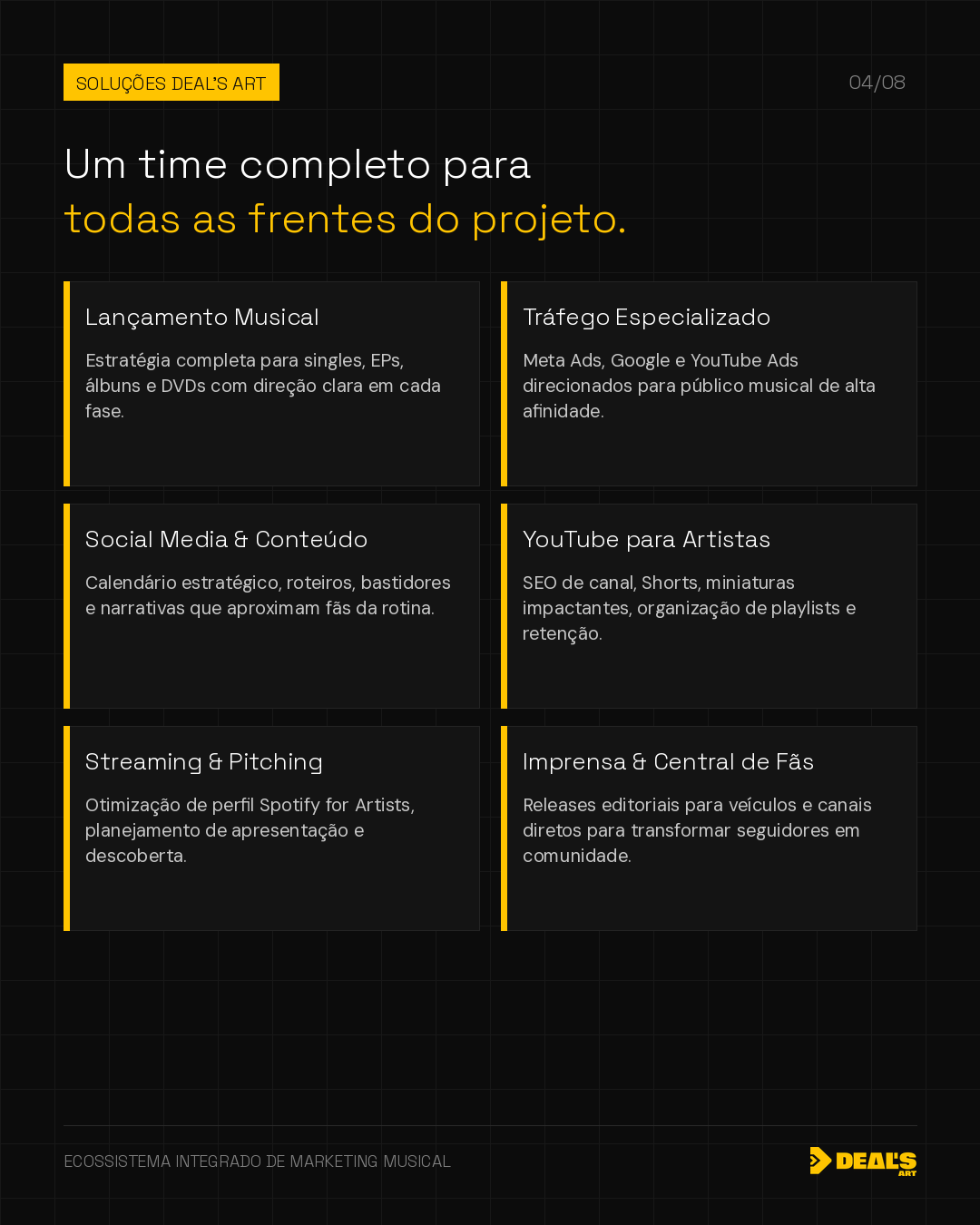
Deal's Art offers a commercial diagnosis focused on aggregator compatibility with compensation models and reporting, without promising automatic results. Our work is to map risks, identify gaps, and propose distribution and music pitching alternatives aligned with the catalog's profile and the manager's objectives. Depending on the scope, we suggest implementation steps and potential technical partners; details about pricing, contracts, and rights are determined on a case-by-case basis. If you prefer, we can refer you to or coordinate specialists when legal or tax issues require dedicated attention.
A consistent strategy connects creation, context, and relationships. If you'd like to organize your next cycle with an integrated perspective, Deal's Art can help define the project's priorities.
Submit my project