
Metadata errors by territory and service cause revenue losses, incorrect payments, and split disputes that drag on for years. With catalogs in multiple versions and across different providers, identifying where and why data fails is urgent for recovering funds and preventing new leakage. This article presents a practical action plan for mapping critical metadata, prioritizing corrections, and integrating reports across platforms. Execution requires technical coordination, legal validation of splits, and ongoing governance processes.
Initial diagnosis: identify gaps and priorities by territory
Start by consolidating release inventories by territory and identifying discrepancies among master files, the distributor, and DSPs. Assess critical fields such as ISRC, UPC, title, version, PLine/P/(C) credits, and composition and sound recording splits. Prioritize items by financial potential, stream volume, and correction complexity. A quick diagnosis helps define the scope of the intervention and estimate the technical and legal effort required.
Mapping by service: understand specific requirements and behaviors
Each streaming service applies its own rules for reading metadata and calculating payments; therefore, map each DSP, store, and territory. Document variations in required fields, character limits, and the handling of featuring credits, remixes, and editorial versions. Monitor how reports and APIs expose registered versus distributed information. This mapping informs transformation rules and automated validation before submission.
Technical plan for corrections and payment reconciliation
Define processes for corrections in source systems, resubmission to aggregators, and follow-up in service dashboards. Include reconciliation steps across DSP, provider, and internal reports to detect pending or incorrect payments. Use ingestion logs and metadata version history to prove changes and support adjustment requests. Establish review cycles after each correction to verify its effects on revenue reports.
Split governance and legal validation of credits
Aligning splits requires documented records and, in many cases, contracts or signed statements between rights holders. Create a validation workflow that integrates contractual evidence, collecting society codes, and notifications to distributors. Implement checkpoints to review split changes before final submission to services. Governance reduces the risk of disputes and facilitates future audits.
Criteria for hiring or carrying out metadata corrections
Assess providers based on their technical experience with DSP APIs, data integration capabilities, and understanding of music publishing processes. Check whether the team offers log audits, version-history procedures, and support for documentary evidence in split disputes. Prefer partners who clearly explain scope, deliverables, and limits of responsibility; when there are questions about contracts or rights, consult a lawyer specializing in music. Require a project plan with milestones, validation tests, and acceptance criteria before hiring.
Why consider Deal's Art for execution without promises of results
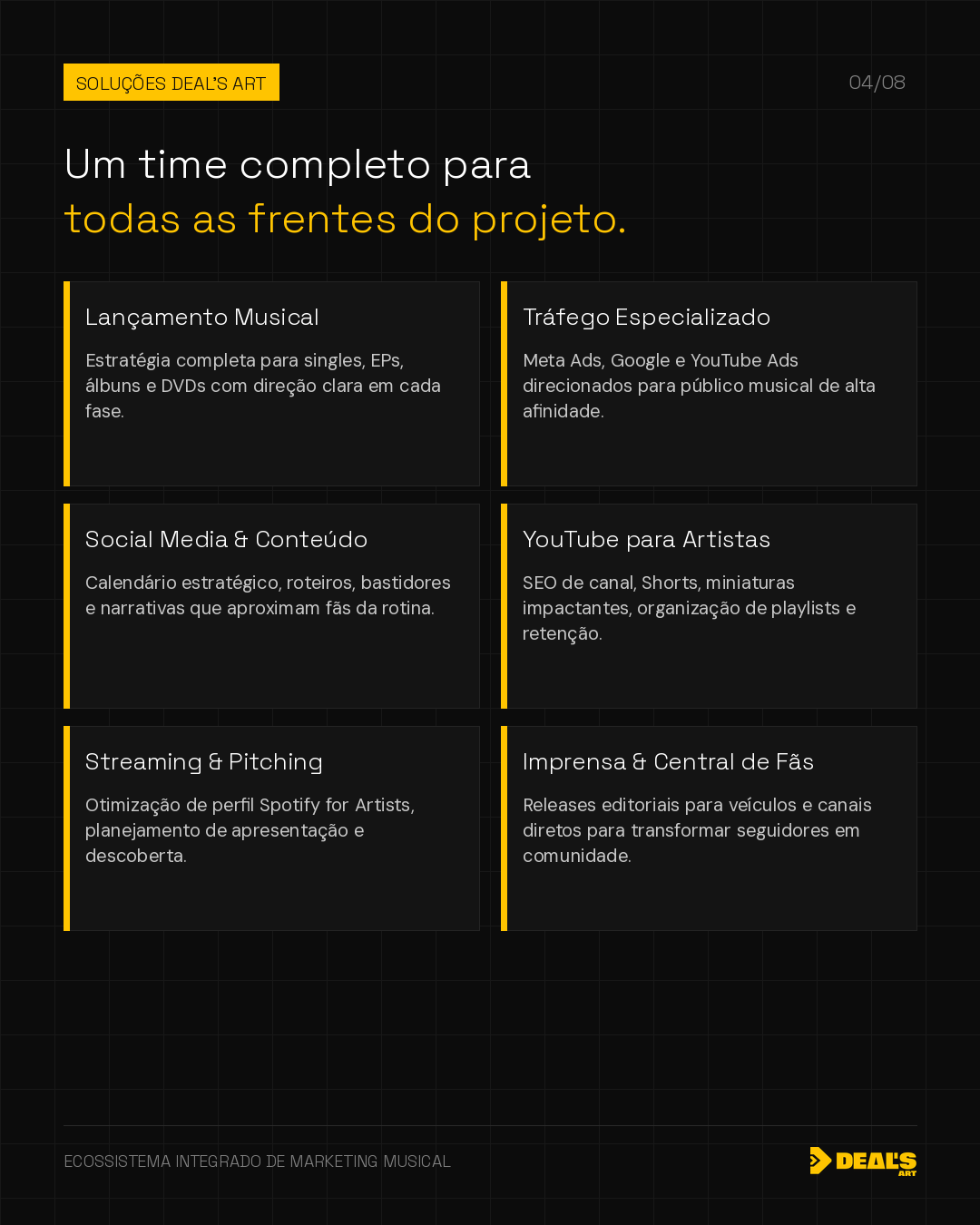
Deal's Art works with streaming and music pitching services, integrating technical diagnosis, metadata correction, and report assembly across platforms. We work with audit processes, source integration, and split governance, proposing a scope based on catalog complexity and client requirements. We do not promise automatic results; we explain possibilities, dependencies, and the type of evidence needed to request adjustments from services and partners. For projects involving multiple territories and stakeholders, we can provide a detailed technical and commercial proposal based on the initial diagnosis.
A consistent strategy connects creation, context, and relationships. If you want to organize your next cycle with an integrated perspective, Deal's Art can help define the project's priorities.
Present my project