
Many artists and labels invest in ads without knowing exactly who they are speaking to, leading to wasted budget and slow learning. Mapping priority audiences and aligning creative assets with those segments is essential to obtain relevant response signals. It is urgent to structure well-defined tests before increasing investment or scaling campaigns. This article offers an operational roadmap for identifying audiences most likely to respond and running the first paid-traffic testing iteration.
Why map priority audiences before running ads
Without clear mapping, campaigns tend to scatter messages and data, making decisions about creative assets and budget allocation more difficult. Identifying segments with similar interest hypotheses makes it possible to test specific messages and measure actionable signals. The process reduces the time it takes to discover where to concentrate initial investment, although results depend on execution and the project's context. Mapping audiences also organizes A/B tests and facilitates the interpretation of metrics such as click-through rate and cost per action.
How to build audience profiles with testable hypotheses
Start by listing audiences based on available data: listeners by city, genre, age range, musical interests, consumption habits, and behavior on social networks. For each profile, define a clear hypothesis about what should motivate the action (for example, watching a music video, pre-saving, or signing up for the email list). Document the data source and confidence level for the hypothesis. Well-described profiles make the testing roadmap replicable and help you choose appropriate success metrics.
Roadmap for creative variations by segment
Associate 2 to 3 creative variations with each audience, exploring different angles: spotlighting the artist, the story behind the song, audio clips with captivating visuals, or an exclusive offer (pre-save, tickets). Describe the format, duration, and call to action for each variation, as well as priority visual and audio elements. Plan minimal adaptations for different channels (feed, stories, shorts). Matching the audience hypothesis to the message is what enables useful learning from the metrics.
Testing schedule, metrics, and decision criteria
Structure the first iteration in 7-to-14-day cycles for each audience set, allowing signals to be collected without prolonging the iteration. Define primary metrics (click-through rate, conversion rate for the desired action) and secondary metrics (CTR, cost per click, engagement). Establish decision criteria: for example, keep variations with relative performance more than X% above the baseline, pause segments with a CPA above a defined cap, and gradually scale the winners. Document learnings after each cycle to adjust hypotheses.
Criteria for hiring a professional or professionally running paid-traffic campaigns
Assess experience with campaigns for artists and relevant formats, requesting examples of test planning and optimization processes (without requiring promises of results). Confirm measurement practices, account access, and reporting transparency policies. Consider the technical ability to use granular targeting, create variations, and manage budgets across multiple cycles. For questions about contracts, rights, and investment, consider consulting a specialist, since scope and terms depend on the project.
How Deal's Art can help you put together your testing roadmap
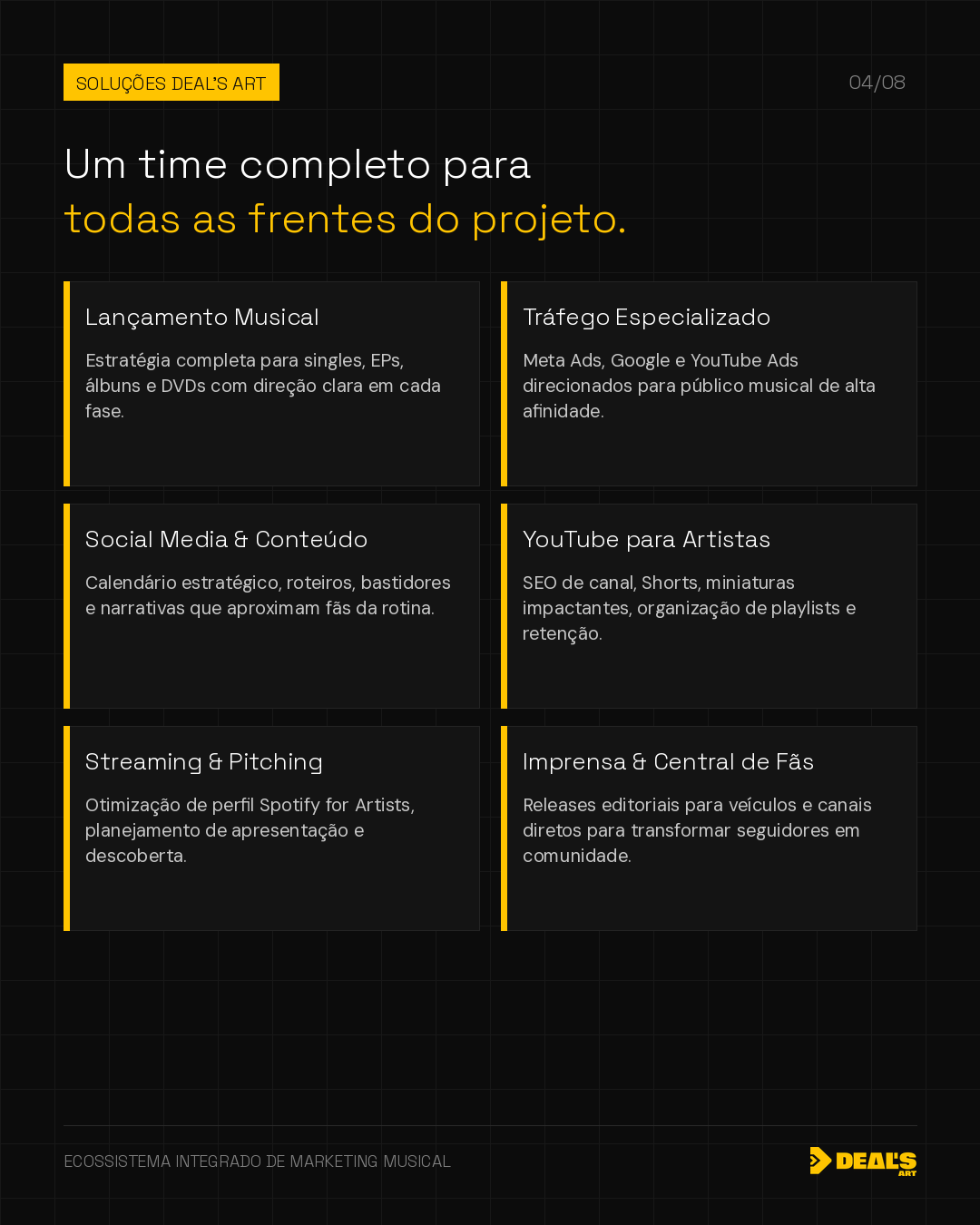
Deal's Art offers a paid-traffic service for artists focused on structuring audience mapping, defining creative variations, and providing a testing schedule with decision criteria and a budget estimate for the first iteration. We do not promise automatic results; we present a replicable process that generates useful response signals depending on the context and execution. If you are looking for an operational roadmap aligned with your catalog, we can schedule a meeting to detail the scope, timelines, and specific needs of the project.
A consistent strategy connects creativity, context, and relationships. If you want to organize your next cycle with an integrated perspective, Deal's Art can help define the project's priorities.
Present my project