
Teams and artists who rely on YouTube often face stalled growth because of poorly structured tests of titles, thumbnails, and publishing windows. Without a tactical process, hypotheses remain vague, results are inconclusive, and resources are wasted. The urgency increases as competition and the cost of reach grow, requiring faster testing cycles and decisions based on clear criteria. This article shows how to organize review and experimentation to get actionable signals in weeks, not months.
Quick diagnosis: which hypotheses to validate first
Start by mapping hypotheses with a focus on clear signal gains and low execution costs. Prioritize variations that affect click-through rate (CTR) and initial retention: for example, title format (emotional vs. informative), thumbnail visual contrast, and publishing times. Avoid testing multiple variables simultaneously in the same set of videos; this complicates attribution. Set a learning goal for each hypothesis, such as a minimum observable CTR difference in X views, to decide whether it is worth continuing.
A/B test structure for titles and thumbnails
Implement A/B tests in groups of videos with similar content to reduce content-related noise. Use pairs of videos or alternative versions over a short period, keeping everything constant except for the element being tested. Track primary metrics (CTR, retention rate in the first 30 seconds, average view duration) and secondary metrics (subscriptions generated, engagement). Plan enough repetitions so that signals are not the result of organic fluctuation or paid promotion.
Publishing calendar and testing windows
Sequence publications to maximize statistical validity and production logistics. Set up testing windows that account for the target audience's day of the week, time, and time zone, maintaining consistency to minimize external variables. For fast cycles, work with 2- to 4-week windows per hypothesis, balancing publication volume and analysis capacity. Document promotions or external actions carried out during the period, as they influence results and must be controlled.
Designing short scripts to accelerate learning
Adopt short, repeatable scripts with retention hooks in the first 10–30 seconds; this increases comparability between versions. Standardize the opening hook, content delivery, and CTA to reduce variation between videos. Test small changes to the hook or content order before changing costly production elements. Maintain a backlog of approved variations to speed up production when a hypothesis needs to be tested at scale.
Practical criteria for hiring or executing with an in-house team
Choose professionals or providers with proven experience in digital experimentation and reading YouTube metrics, preferably with a track record in music or artist content. Assess their capabilities in hypothesis development, controlled test design, basic statistical analysis, and agile production of thumbnails/titles. Require clear documentation processes and decision checkpoints (reporting frequency, criteria for stopping or scaling). For questions about scope, rights, and investment, consult a specialist; budgets and contracts depend on the project's complexity.
How Deal's Art can help implement the experimentation plan
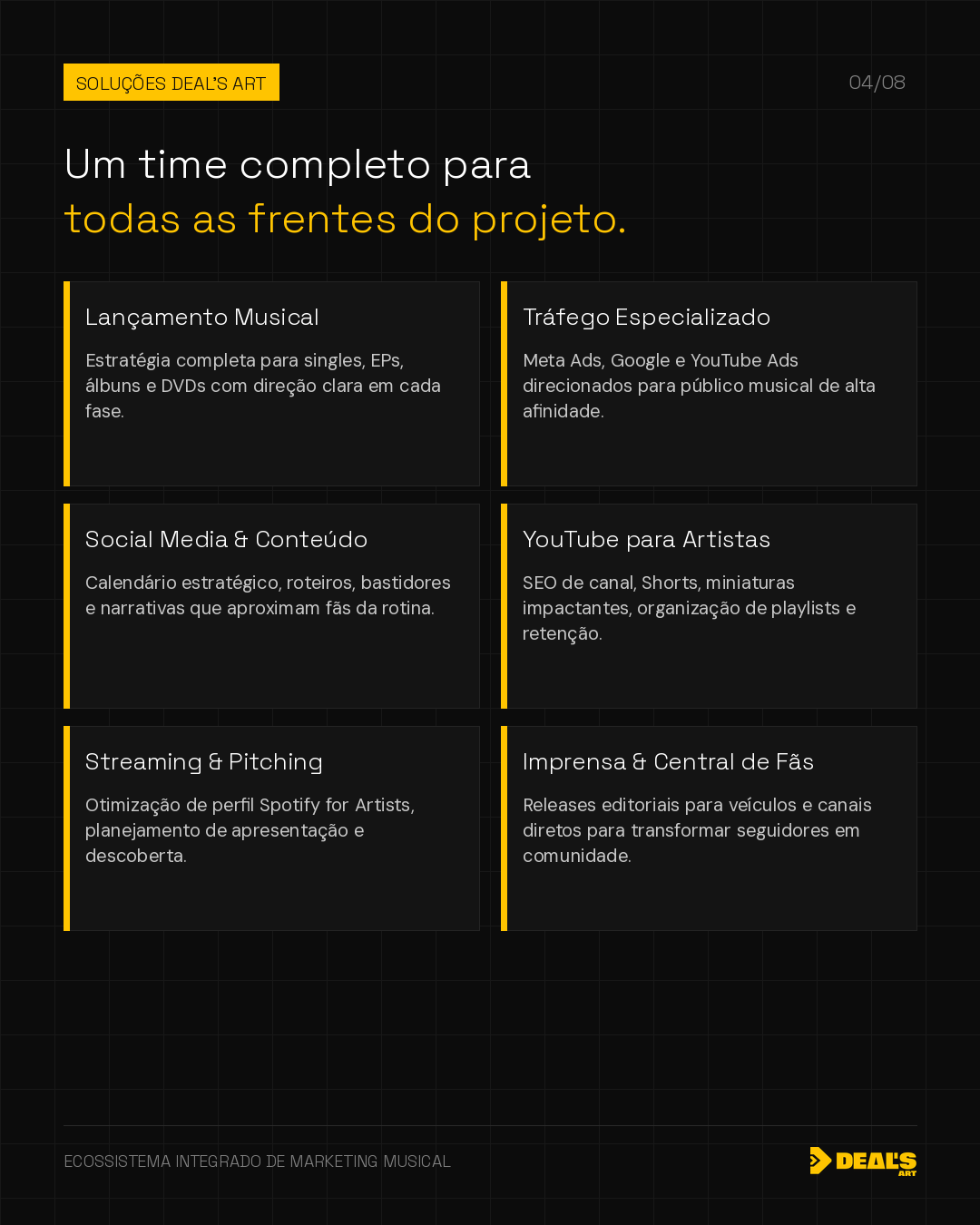
Deal's Art provides strategic planning for YouTube focused on artists and marketing teams, supporting everything from hypothesis design to running test cycles. We can structure a publishing calendar, short scripts, and thumbnail/title variations, as well as define decision criteria and resource estimates. We do not promise specific results; what we offer is a method, experiment governance, and deliverables that enable informed decisions. To define the detailed scope and budget, schedule a planning meeting.
A consistent strategy connects creativity, context, and relationships. If you'd like to organize your next cycle with an integrated perspective, Deal's Art can help define the project's priorities.
Present my project