
Producing a YouTube music video without a clear production workflow leads to delays, extra costs, and missed performance opportunities. Consistent channels require standardized deliverables, realistic timelines, and metrics that anticipate rework. This article describes a production workflow focused on reducing revisions, saving time, and aligning deliveries with channel goals. The urgency is simple: the sooner you standardize processes, the fewer resources you will waste on corrections.
Creative Planning and Technical Brief
Start with a single brief that brings together artistic goals and YouTube’s technical requirements: format, duration, versions (full-length, vertical, teaser), captions, and chapters. Define the target audience and visual communication guidelines to avoid ad hoc decisions during production. Include a preliminary shot list and visual references to reduce differences in interpretation among the director, artist, and production company. A well-defined brief is the foundation for realistic timelines and clear deliverables.
Standard Schedule and Milestones
Build a schedule with fixed milestones: pre-production, filming, offline editing, color correction, audio mixing, version delivery, and publication. For each stage, set deadlines in business days and include buffers for unforeseen issues; this prevents the schedule from being compressed in ways that increase rework. Set review windows with a limit on the number of rounds to control scope. Written status updates at each milestone reduce rework caused by misalignment.
Technical Deliverables and Required Formats
List the required deliverables: a high-resolution master, an H.264/H.265 file for upload, a short version for Shorts/Reels, a vertical 9:16 version when applicable, proxies for review, and SRT captions. Standardize color specifications, audio level (LUFS), codec, and naming conventions to avoid re-exports. Include a QC checklist before approval for the next stage. Clear deliverables reduce rework caused by technical incompatibility.
Quality Metrics That Reduce Revisions
Use objective metrics to approve stages: color match between scenes (% acceptable variation), loudness compliance (LUFS), no clipping, lip-sync alignment, and captions with accurate timing. Define documented acceptance criteria for each deliverable to avoid subjective feedback requesting aesthetic changes outside the scope. Measure rework rates by stage and adjust processes when you detect frequent returns. Clear metrics turn preferences into actionable requirements.
Criteria for Hiring a Team or Producing In-House
Assess in-house capabilities against project complexity: if you have a director, editor, and color and audio team, you can reduce costs; otherwise, consider a production company that can deliver the entire workflow. Hire professionals or vendors with portfolios and documented processes, request proof of technical deliverables (master, SRT, versions), and ask for references regarding deadlines met. Define a contract with a clear scope, limited revision rounds, and clauses covering file ownership and backups. For questions about rights, pricing, and contract formats, consult a legal or business specialist.
How Deal's Art Fits into the Production Process
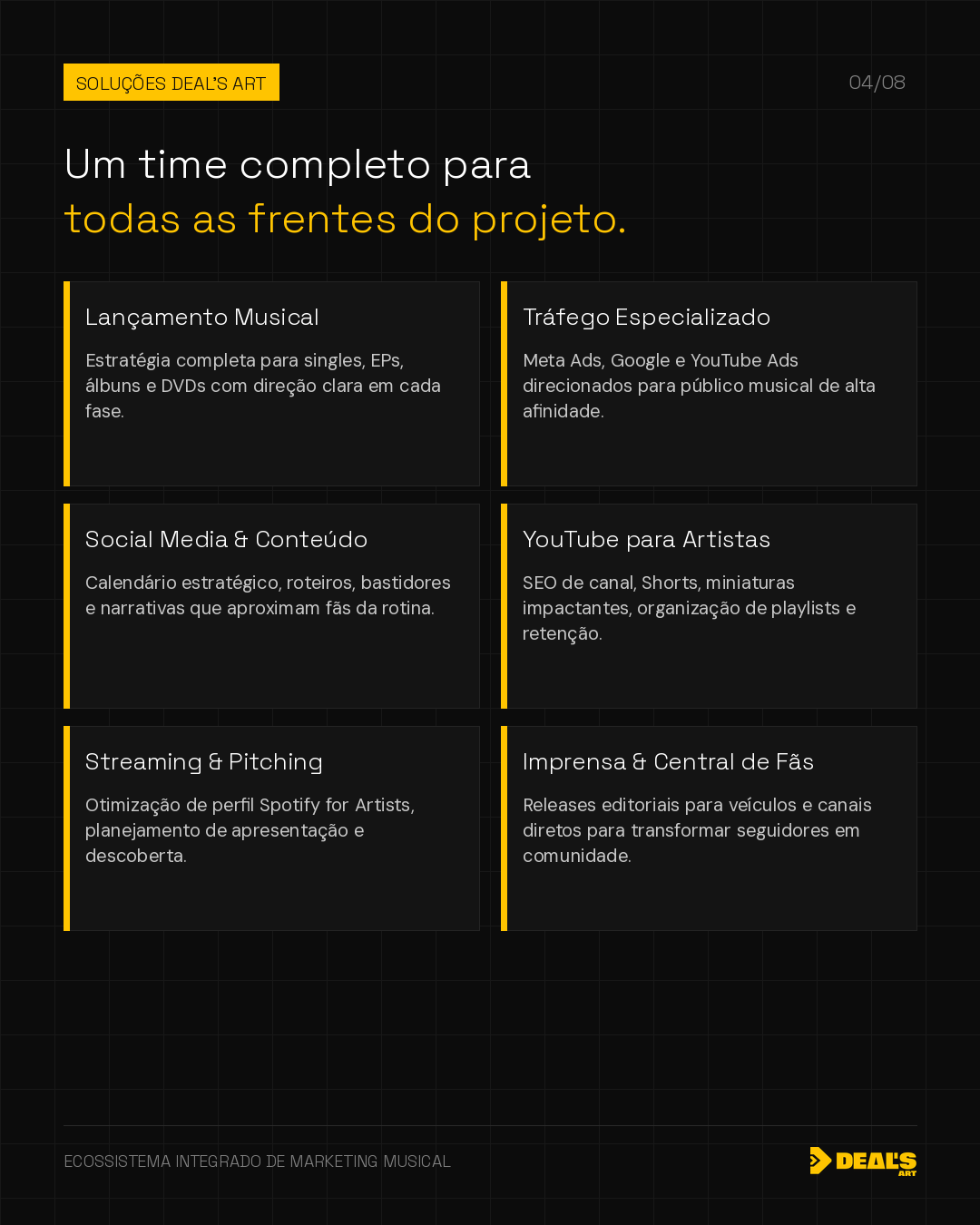
Deal's Art offers production and schedule management services focused on quality and YouTube channel efficiency for artists and labels. We organize the brief, schedule, technical checkpoints, and delivery of upload-ready packages, while respecting the scope defined by the project. We do not promise audience results; we connect production to the goal of having consistent videos and optimized deliverables. For pricing estimates, contracts, or questions about rights, we assess each project and, if necessary, recommend seeking specialist advice.
A consistent strategy connects creation, context, and relationships. If you want to organize your next cycle with an integrated perspective, Deal's Art can help define the project's priorities.
Present my project